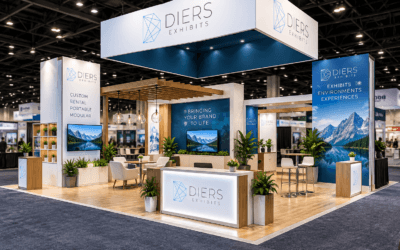
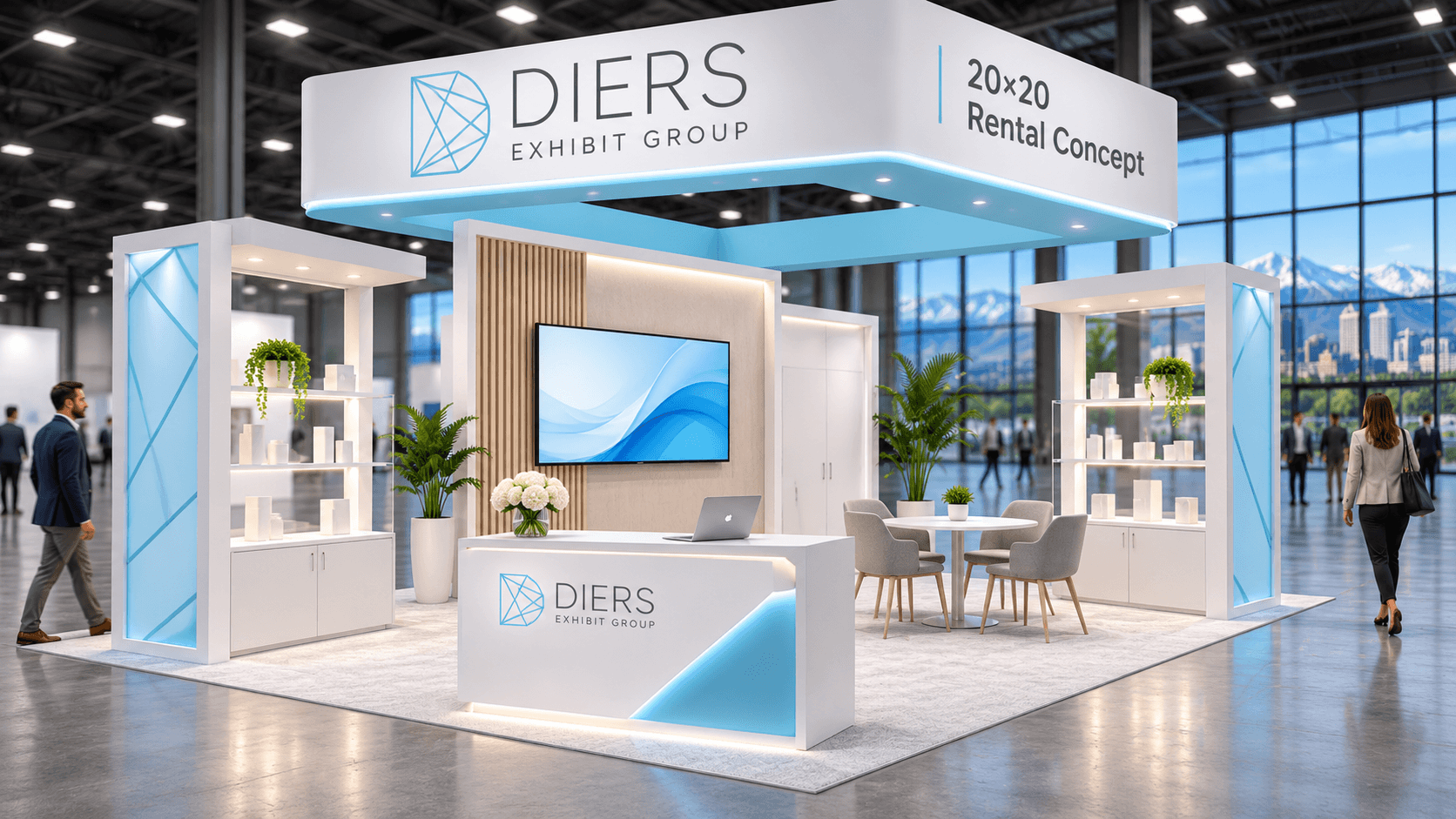
Conceptual rendering of a 20×20 trade show booth rental. For illustrative purposes only; not an actual Diers Exhibit Group installation.
A 20×20 trade show booth gives exhibitors 400 square feet to introduce products, meet prospective customers and create a memorable brand experience. But getting the most from that space requires more than choosing an attractive display.
The layout needs to support how your team will interact with visitors. That means thinking about product demonstrations, meeting areas, brand visibility and the practical requirements of the show floor.
For companies exploring 20×20 trade show booth rentals in Denver, a customized rental exhibit can provide a flexible way to create a professional environment without purchasing an entirely new booth structure.
At Diers Exhibit Group, we help businesses plan branded rental exhibits that align with their event goals and presentation needs.
Here’s what to consider before planning your 20×20 exhibit.
Understanding the 20×20 Trade Show Booth Footprint
A 20×20 exhibit measures 20 feet by 20 feet, providing 400 square feet of floor space.
At many trade shows, a 20×20 booth may be configured as an island exhibit with aisles on four sides. However, the assigned booth location and event regulations determine which sides are open and how the space can be used.
Before developing a design, confirm the booth’s location on the official floor plan.
That information helps determine where visitors can enter, which directions offer the strongest visibility and where structural elements can be positioned.
A 20×20 footprint may accommodate:
- Product demonstrations and interactive displays
- Branded reception counters
- Digital screens and presentation areas
- Small meeting or consultation spaces
- Product shelving and display fixtures
- Concealed storage for supplies and personal items
The goal isn’t to include every possible feature. It’s to choose the elements that directly support your exhibiting objectives.
Three Ways to Design a 20×20 Rental Booth
The best 20×20 booth layout depends on what visitors should experience when they approach your exhibit.
1. Demonstration-Focused Layout
For companies showcasing equipment, technology or physical products, demonstrations may be the primary attraction.
A demonstration-focused layout can position the main product presentation where attendees can see it from an approaching aisle.
Smaller stations may support individual conversations while a reception counter gives staff a place to welcome visitors.
Best suited for: Product launches, equipment demonstrations and interactive presentations.
Planning consideration: Allow sufficient room for people gathering around demonstrations without obstructing visitor circulation or neighboring booths.
2. Meeting-Focused Layout
Some companies attend trade shows primarily to meet distributors, existing customers or prospective business partners.
In this situation, the exhibit can prioritize comfortable discussion areas instead of numerous product displays.
A central branding feature can establish visibility while consultation areas offer space for more focused conversations.
Best suited for: B2B service providers, enterprise technology companies and relationship-driven sales teams.
Planning consideration: Meeting furniture occupies valuable space. Consider how many conversations need to happen simultaneously and whether any level of privacy is necessary.
3. Multi-Product Presentation Layout
Companies representing several product lines may want separate branded presentation areas within one exhibit.
For example, different stations can highlight individual products while using consistent colors, graphics and architectural elements to maintain one recognizable brand experience.
Best suited for: Consumer product companies, manufacturers and exhibitors with multiple product categories.
Planning consideration: Too many displays can make the booth feel crowded. Give priority to the products or messages most likely to generate meaningful conversations.
How to Make a 20×20 Island Booth Work From Multiple Aisles
When a 20×20 booth has four open sides, the design must communicate effectively from several directions.
Unlike an inline booth where visitors generally approach from one main aisle, an island exhibit may attract people from different parts of the show floor.
Three considerations deserve particular attention.
Establish a Clear Visual Focal Point
Visitors should be able to recognize your brand and understand what you’re presenting without studying the entire booth.
A strategically positioned branded structure, digital presentation or product display can help establish that focal point.
Its placement should reflect the confirmed aisle exposure and the event’s height and visibility restrictions.
Keep Entrances Inviting
A large reception counter or oversized display placed near an entry area can unintentionally discourage visitors from walking farther into the booth.
Consider positioning welcoming elements where they guide attendees toward the main experience without creating an unnecessary barrier.
Separate Conversations From Active Demonstrations
A visitor participating in a demonstration has different needs from someone having a detailed sales conversation.
Giving these activities distinct areas can help staff manage interactions and reduce competing distractions.
Even within 400 square feet, thoughtful zoning can make the exhibit feel more organized and purposeful.
20×20 vs. 10×20 Trade Show Booths: Which Is Right for You?
A 20×20 exhibit provides twice the floor area of a 10×20 booth, but the difference is more than square footage.
A 10×20 booth provides 200 square feet in a rectangular layout. It is commonly used for inline exhibits where visitors approach from a primary aisle.
A 20×20 booth provides 400 square feet in a square configuration, potentially allowing more flexible placement of demonstration stations, branded structures and conversation areas.
A 10×20 booth may be appropriate when:
- You need a focused product presentation.
- Your team has a limited number of simultaneous interactions.
- The event offers an inline booth location.
- A compact layout supports your goals.
A 20×20 booth may be appropriate when:
- Multiple demonstrations are planned.
- You need separate areas for meetings and visitor engagement.
- Your products require additional display space.
- The event offers an island or other suitable configuration.
More space isn’t automatically the better investment. Choose the footprint that supports your event objectives and overall exhibiting budget.
How Much Does a 20×20 Trade Show Booth Rental Cost?
A 20×20 booth rental does not have one universal price.
The investment depends on the exhibit design, rental components, branding requirements and services needed for the specific event.
For example, a straightforward branded display with counters and standard graphics will have different production and coordination requirements from an environment featuring integrated audiovisual systems, custom architectural elements and multiple meeting areas.
When evaluating your budget, consider the scope of the rental exhibit itself as well as separately billed event expenses.
Possible cost considerations include:
- Rental structures and exhibit components
- Custom graphics and branded finishes
- Lighting, monitors and audiovisual integration
- Furniture and flooring
- Freight and transportation
- Installation and dismantling
- Electrical and internet services
- Material handling and other show contractor charges
Some services may be included in a supplier’s proposal while others must be purchased separately through the event organizer or approved contractors.
Before comparing quotes, confirm what each proposal includes.
For a broader explanation of the factors that influence pricing, read our Trade Show Booth Rental Cost Guide.
Why Consider Renting Instead of Purchasing?
Renting can be a practical option when your exhibiting needs change from event to event.
A company may need a 20×20 booth for one industry conference and a smaller footprint for another show later in the year.
A customized rental approach can offer flexibility without requiring ownership of every exhibit component.
It can also be useful when introducing new branding, testing an exhibit concept or evaluating a larger show presence before making a long-term investment.
However, purchasing may deserve consideration when a company attends numerous shows with consistent layout and structural requirements.
The right approach depends on your event calendar, design goals and total cost of ownership.
Diers Exhibit Group offers customizable trade show booth rental solutions for companies exhibiting in Denver and at events throughout the country.
What to Prepare Before Requesting a 20×20 Rental Quote
A clear project brief helps an exhibit partner understand your objectives and evaluate suitable design options.
Before requesting a proposal, gather the following information:
Event details: Include the trade show name, city, venue and scheduled dates.
If your trade show is taking place at the Colorado Convention Center, review the venue’s official exhibitor resources alongside your event’s exhibitor manual to understand applicable services and logistical requirements.
Booth specifications: Confirm your assigned booth number, dimensions, open sides and any organizer requirements.
Presentation objectives: Explain whether you want to emphasize demonstrations, product displays, meetings or lead generation.
Products and equipment: Identify items that need display space, electrical connections or specialized handling.
Brand assets: Provide available logos, graphic files, brand guidelines and messaging.
Staffing and meetings: Estimate the number of team members working in the exhibit and the types of visitor interactions you expect.
Event schedule: Share relevant move-in deadlines, installation requirements and any additional shows where the exhibit may be used.
Budget: Provide a realistic budget range and specify whether it covers only the exhibit or your entire trade show participation.
These details make it easier to develop a proposal around the project rather than relying on a generic booth package.
Plan Your 20×20 Trade Show Booth Rental With Diers Exhibit Group
A successful trade show exhibit should do more than look impressive. It should help your team introduce your brand, present your products and create opportunities for meaningful customer relationships.
Diers Exhibit Group works with businesses in Denver and nationwide to develop customized rental exhibits supported by exhibit design, logistics coordination and show services.
Whether you’re planning a 20×20 island booth or exploring another configuration, our team can help you evaluate an exhibit solution that fits your event requirements and business objectives.
Ready to discuss your next trade show?